
PROGRAM
Trio Guadalevín
Wade Davis, Cello presented by Early Music Seattle
Cascade Conductors and Composers
Shining Sea (Seattle Premiere).......................................Oliver Ellsworth
In reflecting on the 250th anniversary of the founding of the United States, I was immediately drawn to the vast and uniquely varied natural landscape of this country as inspiration. As the title might suggest, Shining Sea focuses on the natural beauty found in and around the two coasts of the United States. I wanted the piece to evoke feelings of the natural beauty surrounding the coasts that makes this country so special. The title, Shining Sea, is taken from the last lines of Katherine Lee Bates’ anthem “America the Beautiful”: …from sea to shining sea.
Scherzo (Seattle Premiere).........................................Zachary Landress
Scherzo is a playful, energetic work whose humor comes from its efficiency and playfulness. A solemn, brooding introduction ironically gives way to music built on jest, momentum, and musical optimization. The word ‘scherzo’ literally translates from Italian as “joke.” In music, the term is used to describe works that possess a playful, mischievous, or lighthearted character. The scherzo as a musical form developed during the late eighteenth century, coinciding with the founding and early history of the United States. Like our nation, Scherzo takes a traditional Western form and reimagines it for the modern world. It embraces inherited conventions while interpreting them through musical modernity.
Little Dances (Seattle Premiere)....................................Amara Farah
“Little Dances” is a lighthearted piece embodying a celebration of identity and life. I was inspired by a song that my father frequently sang to me growing up, "Imani Sate'e" ( إيماني ساطع ), which speaks of perseverance in dark times and looking forward to brighter days ahead. I included a melody, which is similar to the song, throughout the piece, and I composed joyful music around it to inspire feelings of dance and celebration.
Yove (Seattle Premiere)................................................Nicole Balsirow
Yove, or Йови in Kalmyk, is the imperative form of “to go” in English. It’s the need to move or a command that someone would say. The piece carries this momentum using Kalmyk folk tunes, instrument combinations, evoking the steppe, and culminates in a final lurch after the will is imposed on the ensemble.
Mountain Wanderings (Seattle Premiere).....................Griffen Collins
Mountain Wanderings muses on a sort of peace found when one is lost. It is partly inspired by the meadows of Mount Rainier National Park, and it attempts to gaze at unfamiliar landscapes through a child’s eyes. Through interruptions, cloudy visions, and illusions of purpose, the piece evokes an optimistic view of a fearful situation and finds solace in an unfamiliar place.

About the Performers
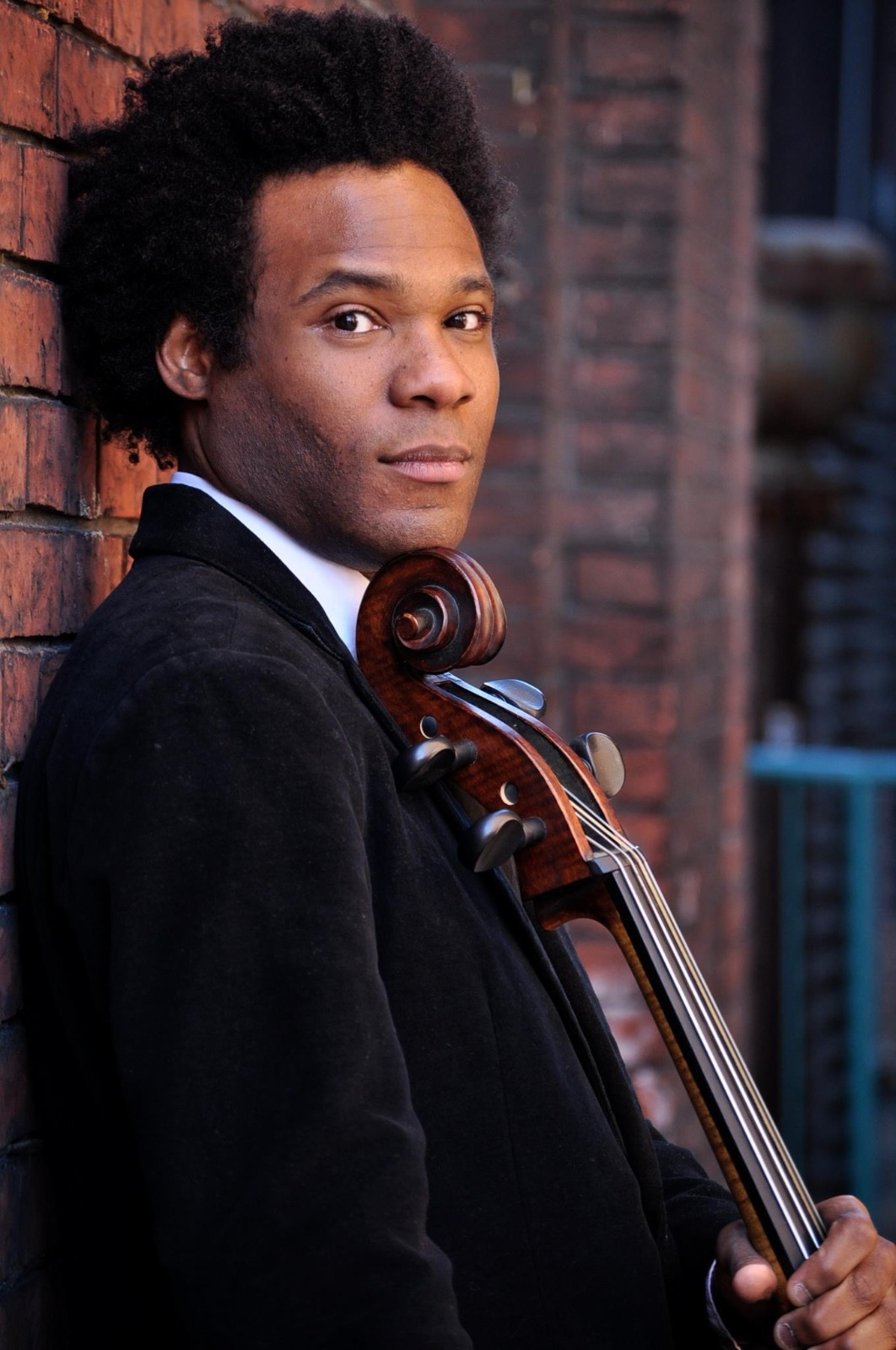
Wade Davis
Wade Davis was born in New York in 1982. At the age of seven, he began studying the cello in the String Project at the University of South Carolina, in Columbia, South Carolina. After two years of studying privately with Ashley Gobbel, Wade began studying with Dr. Robert Jesselson, Professor of Cello at the University of South Carolina. Wade was the winner of the South Carolina Philharmonic Jr. Young Artist's Prize in 1998 and the South Carolina All-State Orchestra Concerto Competition winner for 2001. Wade's studies continued with Dr. Jesselson for eight years until Wade's graduation in the Inaugural Class of 2001 at the Governor's School for the Arts and Humanities. He then attended the North Carolina School for the Arts in Winston-Salem. After two years of tutelage with Marcy Rosen, Wade transferred to the College of Charleston where he completed his undergraduate studies with Professor Natalia Khoma. He then obtained both a Master's Degree in Baroque Cello Performance and a Graduate Performance Degree in Historical Cello from Peabody Conservatory of Johns Hopkins University as a student of John Moran.

Trio Guadalevín
Trio Guadalevin explores the musical connections between Mexico and the Mediterranean. Together, percussionist Antonio Gomez (Associate Director of Education, Tacoma Arts Live) and multi-instrumentalists Abel Rocha (founding member of Correo Aereo and Los Flacos) and August Denhard (founder of Eurasia Consort, Executive Director of Early Music Northwest) explore and often reimagine the dialogue between Indigenous, European and African cultures, which defines Latin American music and identity. The ensemble takes a fresh, innovative approach to music with deep roots: from the son huasteco and son jarocho of Mexico, to Afro-Oaxacan music, Sephardic Jewish melodies, Spanish fandangos and xicaras, Arab-Andalusian song and Italian ciaccona and tarantella. Instruments featured in their performances include the guitar, oud, theorbo, baroque guitar, vihuela, jarana, quinta huapanguera, harp, bendir, riqq, bombo, pandero cuadrado, pandereta, teponatzli, cajon and more.

Cascade Conductors and Composers
With the motto of "Excellence through Equity," Cascade Conducting is dedicated to bringing world- class musical education to talented and diverse musicians from the US and around the world. Conceived by Paula Madrigal, Sarah Ioannides, and Teo Benson in 2017, Cascade Conducting is officially a program of Orquesta Northwest, a 501(c)3 non-profit.
Since 2018, Cascade Conducting has given out 30 full tuition scholarships equaling more than $70,000 to exceptional young conducting and composing students, with a focus on engaging talented BIPOC (Black, Indigenous, People of Color) musicians who may not have access to traditional avenues or opportunities.
Gaining truly international status, the Orchestral Masterclass has welcomed conductor's from England, Australia, Iran, China, Argentina, Mexico, Canada, Costa Rica, Israel, and Ecuador.
A unique pedagogical philosophy has formed the mission of Cascade Conducting, which seeks to provide a unique map for navigating the world of music and conducting, and to find balance between the demands of the business, and the preservation of one’s individual musicianship as a necessity to achieve excellence.